
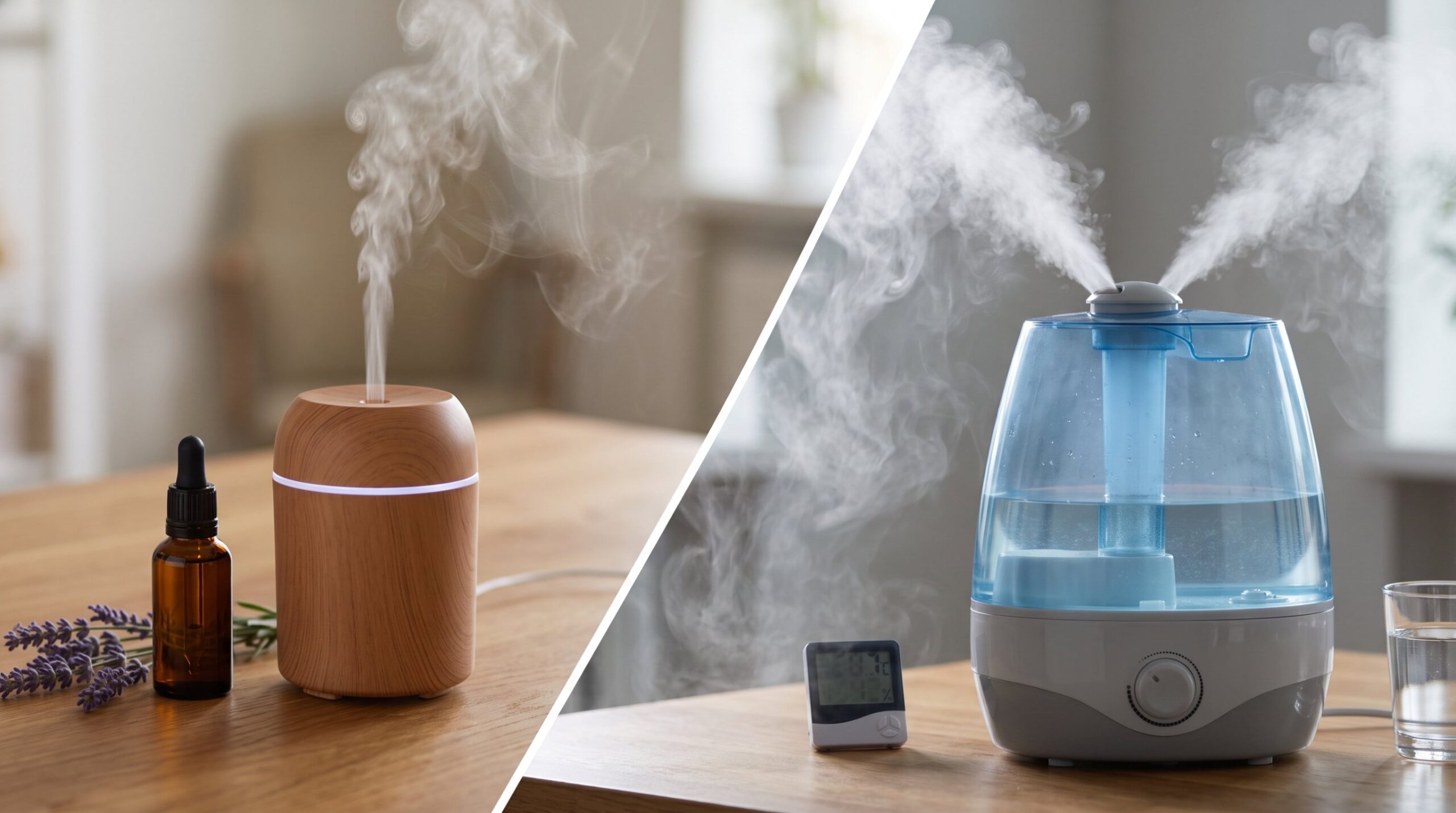
Aroma Diffuser vs Humidifier: What Is the Difference?
Aroma diffusers and humidifiers look so alike that it’s easy to mix them up. Both turn water into a soft little cloud, but they have very different jobs, and picking the wrong one can mean wasted money, a stuffy room or even a damaged machine. Let’s untangle them so you can choose the right one for your home.
The short answer
A diffuser is for scent. It uses a small amount of water and a few drops of essential oil to fill a room with fragrance. A humidifier is for moisture. It adds a meaningful amount of water vapour to dry air. A diffuser barely changes a room’s humidity, and a standard humidifier isn’t built to handle essential oils. Think of it as a perfume bottle versus a glass of water for the air.
Side by side
| Aroma diffuser | Humidifier | |
|---|---|---|
| Main purpose | Fragrance and atmosphere | Add moisture to dry air |
| Water tank | Small (often 100 to 300 ml) | Larger (often 2 to 6 litres) |
| Effect on humidity | Minimal | Noticeable in a small room |
| Essential oils | Designed for them | Usually not recommended unless the maker says so |
| Run time | A few hours, often with auto-off | Many hours, sometimes overnight |
| Cleaning | Rinse often, wipe away oil residue | Clean regularly to prevent buildup and mold |
| Best for | Spa-like evenings, small rooms | Dry winters, heated homes, stuffy rooms |
How each one works
Diffusers
Most home diffusers are ultrasonic: a tiny plate vibrates to make a cool mist from water and oil. Others are nebulizing (no water, just oil broken into fine particles), evaporative (a fan blows air over a scented pad) or heat-based. Ultrasonic models are the crowd favourite because they’re quiet and affordable.
Humidifiers
Humidifiers come as cool mist (ultrasonic or evaporative) or warm mist (the water is heated). They’re made to run for long stretches and move far more water, raising the humidity in a room. Many homes get desert-dry in winter, and a humidifier can make the air feel so much more comfortable.
Can you put essential oils in a humidifier?
Usually not! Many humidifier makers say no oils, because they can damage plastic parts, clog the unit or leave residue behind. A few models have a special oil tray or are sold as combination units. Always read the manual first and follow it.
Which one should you choose?
- You want a lovely scent and a calm mood: choose a diffuser.
- Your home feels dry (itchy skin, static shocks, a scratchy throat): choose a humidifier.
- You want both: use two separate machines, or look for a combination unit that’s designed for it.
- You have a very small room or desk: a compact diffuser is usually plenty.
You can find some amazing diffusers and humidifiers on Amazon. (Affiliate link: see our Affiliate Disclosure.)
Care and safety
- Keep it clean. Empty, rinse and dry the tank often, and follow the maker’s cleaning schedule so bacteria and mold don’t move in.
- Use the right water. If your water is hard, many makers recommend distilled or demineralized water to avoid white dust.
- Keep an eye on humidity. A range of roughly 30 to 50 percent is commonly recommended. Too much moisture can encourage mold and dust mites, and a small hygrometer is an inexpensive way to check.
- Place it thoughtfully. Set it on a stable, water-safe surface a few feet from walls, bedding and electronics.
- Go gently with scent. A few drops is all you need, since strong fragrance can bother some people.
Pets, little ones and sensitivities: Some essential oils can be harmful to pets, especially cats, dogs, birds and small animals, as well as young children. People with asthma or sensitivities may also react to strong scents. If you share your home with any of them, check with your vet or doctor first, keep the room ventilated, run the diffuser for short periods, and make sure pets can leave the room. Always store oils well out of reach.
Using one in your evening routine
A diffuser is an easy way to add a scent cue to your wind-down, and a humidifier can make a dry bedroom feel so much cozier. Our 30-minute bedtime wind-down routine shows where scent fits in alongside light and sound.
Questions you might have
Does a diffuser clean the air? Nope, it adds fragrance, not filtration. If air quality is on your mind, an air purifier is the thing to look at.
Can I run it overnight? Humidifiers are often made for it. Diffusers with auto-off are best for shorter sessions. Check what your model recommends.
Which is better for a small bedroom? If the air feels dry, start with a small humidifier. If you simply want a cozy scent, a diffuser will do the job beautifully.
There’s plenty more where this came from. Find more simple ideas on our blog.